
Graduation
05/01/26

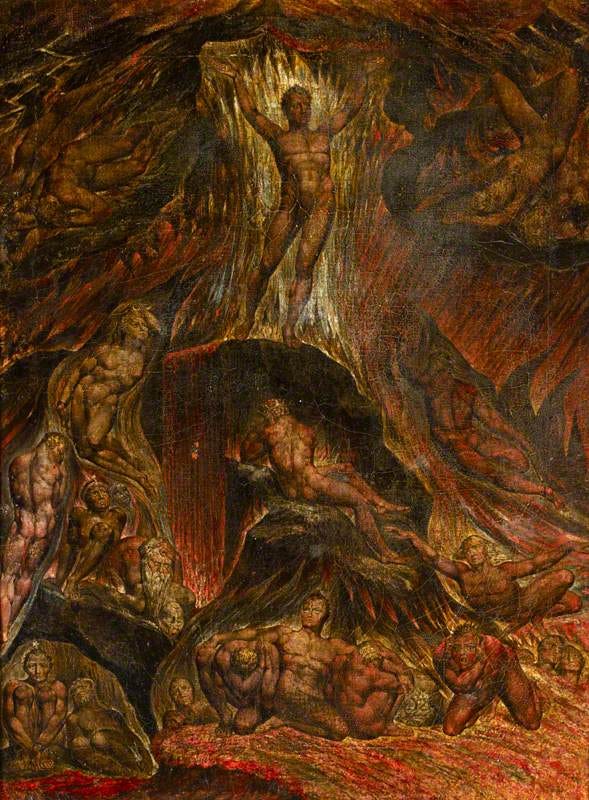
“The primary IMAGINATION I hold to be the living Power and prime Agent of all human Perception, and as a repetition in the finite mind of the eternal act of creation in the infinite I AM.” – Samuel Taylor Coleridge
A child’s imagination is a sacred playground. Everything is holy, everything is new. The child is ignorant of the world and of themselves. When I was a toddler, I made up my first superhero, Glove Head, a man with “every power in the world” but who could use only five at a time (when he used one, a finger of the glove on his head would stick up to indicate its use).
Children do not have the knowledge, the capacity of thought, to create as adults do. Instead, they create only because they must. This leads to an individual enchantment, to the romantic child who is content in her own existence and does not divide the perceived from the imagined. Yet her creations are lackluster, they are boring and quotidian to the adult masses who see through them. Candyland is a grueling experience for any sober adult without the help of children who delight in it. The same can be said of the dolls that enchant children’s lives, but which are unsettling to adults whose imaginations can not bring the mass of felt and beads to life.
When children grow up, they lose their particular innocence: That imagination which was untethered and unburdened by questions of morals, of greatness, and even of quality. Childhood ends with the birth of the self, but adulthood only begins with the discovery of the other. The I of the adult is in comparison to the thou of everyone else. The great realization at the end of teenage angst is that others, one’s parents, are people too.
In this moment, something is lost, and something is gained. The true capacity for empathy and humility is gained in the realization of the other. But here everything is lost to doubt. No longer do parents tell truths, but only opinions. There is no correct way forward, and decisions of time and energy become one’s own. The great loss of possibility, of immediacy, is facilitated by doubt, and that doubt is the personal shame which haunts the veins of adulthood.
One definition of guilt and shame is that guilt is personal, you feel bad individually, and shame is communal, the community shames you. This is insightful and true. Another definition is that guilt corresponds to actions and shame to being. Shame is done because of who you are, how you are, what you are. Guilt is the state of having done something, but it is separate from the essence of the I.
In this way, it is a private but communal shame that haunts adults and prevents them from existing as children do. The make-believe games, totally lacking in system, which children play, are lost to adults because they feel shame about them. Adults question the use of such games, of existence without system, of creation without audience—children are the opposite, they must play in private. This shame, though contained in the individual, has everything to do with the communal. When the adult recognizes the other, as children can not, they recognize the self and judge their own being against the beings of others. Being, Ka, Soul, Geist, breath, these are what are discovered by the adult. They themselves are insufficient to reach the fulfillment of childhood.
And yet that fulfillment, though admirable, is itself flawed. Not because it will one day end, but because it knows not the word “no.” Everything is accepted, and yet everything can’t be accepted in life. All children must grow up or remain sheltered in a bubble of existence. This is why those who are childish after getting old leave a vile taste in the mouth of those who encounter them. These spoiled children still believe they can know everything, or maybe that they do.
So it is shame that distinguishes the fallen from the naive. A shame, self-inflicted, but at the closeness of the other. This, too, is what, beyond the sex drive, allows adults to love erotically when children can only love implicitly. The great expanse of eros contains in it the ecstasy of yes and the melancholy of no. It contains the great expansive question of the identity of the self and of the other, the eternally strange and intimately familiar.
So I stand at the edge of this shame at the cliff of adulthood and must choose a direction to fly. I can not fly back, it is gone, as if as soon as I looked forward, what was behind me changed and disappeared into the mists.
At the edge of shame is morality. The experience of others who suffer and live. There is responsibility as one searches for the approval and pride of the respected. More and more, the respected, the mentor, the parent, the teacher, the hero becomes the guide who gives fledgling adults the courage to take off in the pursuit of wonder.
Not the all-encompassing wonder of children, that lush crash of color which echoes from innocent eyes. But the wonder and awe that is reserved for the fallen, which is only found in the rebellious. Those who must always say a thousand nos alongside every yes. This is suffering, eternal and excruciating, but also necessary and powerful.
The question of the present day is that of individual and plural, the internal and the external, the ordinary and the grand. We live in an age of equality. Not an equality that is practiced but one that is mandated, for all men were created equal. Yet each contains distinction. Never again will your particular flame exist in this world, and whether you flicker to the left and in an orange, blue, or white blaze, or to the right with a yellow one, you will be unique and illuminate a new fragment of the night. Is one a genius and one an idiot. Or are both equal and so equally deserving. It is uniqueness that is the key negative aspect of all life, and is all that can be embraced in the other. One cannot control the other, and each must decide what to do, where to fly, even if that destination is death, or, more scary, nowhere.
Here I am, Hineni, the Hebrew bible says. Here are we all, in an age that recalls the world before the wars, in which the learned only destroy and have been thrown to the wayside. In which figures of personality lay their bad ideas as a hoe into the soil of society. Ripping at the roots of the flower bush nearby.
What is to be done. Ought one find quotidian greatness, embrace the ordinary and the easy. Or even the hard steak, which shall remain chewy even after years of flavor have been extracted. What about the world. Does one have an obligation to the political, to assuage the suffering of others. Does one have an obligation to greatness. Not that of recognition or fame but of finding the childlike brilliance hidden beneath the veneer, which is what we see in the mirror. Even the most spoiled child, the blindest sleepwalker, has the human in them. But this does not mean they deserve my pity. They have my sympathy, my connection already. But love is as much a no to others as it is a yes to one. This is where monogamy arrives and also where monogamy dies.
Growing up is a moment of tremendous loss. The grief that is alien memory is one unfathomable in words. When I see actors in films or on stage who can cry at will, I always try the same myself, just until the tears begin, and the world can see. I imagine a world in which my home has burned down, in which my father is a corpse, and my mother has choked on the smoke of burning books. In which my sisters are left charred under the wreckage of splintered beams and acrid plaster. I imagine a world where I inherit everything and nothing. Where I am alone and unwanting. Where the flames have left nothing but ash.
Tears flow in the moment and in the funeral that plays in my head. Images, never first person, but never of me. My friends sob, my family cries. I feel her hands on my shoulders and the tears on my cheeks. This loss is not real, but I can feel it. It is True. What I never know is what I do after the funeral. There is always a wooden pistol on a table waiting to be shot, an enlistment contract waiting to be signed, and a door waiting to be opened, but I never see what is on the other side of the door… or is it a garden?
What is the object of a story like this. To mine out another inch of dirt and unveil another inch of the universe. To delight in prose. To feel that emotion so buried by shame that it could never be familiar. Writing, creating, is about the self and the universe. It is to carve out space in the progression of the family, of this species, which, alone, is burdened by sentimentality. Writing (by which I mean all creation, as all creation exists in language, even if it is not the pneumatic alphabet which defines western civilization, but is instead the immediate pictographic existence which is older, of the Egyptian and the Chinese and the Olmec) is the bridge between work and play, between I and thou, between the smell of a flower and the word of a friend.
It is those who go on in the spotlight of shame who interest me. The great pride of Austria: the Klimt, the Wagner, the Beethoven, the Mozart, the Mahler, the Rilke, the Hofmannsthal, the Wittgenstein, the Zweig, the architecture, the music, the painting, the multicultural empire that spanned the center. The great shame of Austria, the collapse, the suffering of the people, the loss of the war, the end of empire, the murder of the jews. How does one sing and live after this evil and grief and shame and loss. Many do not. They become didactics, authoritarian in mind, they exist only as objects, and sacrifice themselves to the altar of morality. This is easy; this is the enlistment letter on the table, the allure of habit, and philosophy.
Living on is much harder; it is to embrace the nos and the yeses, to shoulder the burden of shame, to give the inner world to the outer and keep safe the souls of one’s company. It is to go onward, to the new, to the west, not to bury the seriousness of the world with ironies of contempt, but to embrace the laughter of kindness and individual experience for the sake of the other, the living strange. How does an Austrian write after Hitler? We must ask Thomas Berhnart and Ingeborg Bachmann. How does a white southerner write after slavery? We must ask Faulkner and O’Connor. How does an adult write after the death of childhood? We must ask the stars. What ought I do with this time but call out one more time Hineni, Here I AM.